ORGANIZED AND STRONG CIVIL SOCIETY
An organized civil society is the cornerstone of a stable and functioning democracy. It is made up of a wide range of non-governmental organizations, community groups, nonprofit organizations, trade unions, and other actors within a rich ecosystem that…
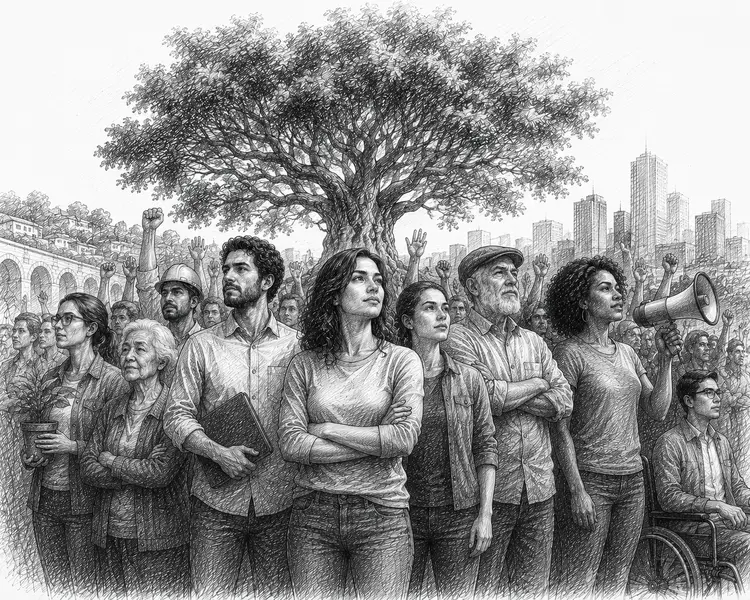
An organized civil society is the cornerstone of a stable and functioning democracy. It is made up of a wide range of non-governmental organizations, community groups, nonprofit organizations, trade unions, and other actors within a rich ecosystem situated between the fundamental social sphere of every society—the family—the State, and the market. These organizations often serve as the voice of citizens, advocating for social issues, providing services, and holding governments accountable. The importance of a structured civil society, therefore, cannot be overstated.
First, civil society provides a check on state power. By organizing, it can influence public policy, propose legislation, and campaign against laws or actions that may be harmful to the public interest. In this way, it acts as a watchdog, helping to ensure government transparency and accountability.
Second, an organized civil society is essential for promoting social cohesion. It can bridge divisions between different social groups by encouraging dialogue, understanding, and cooperation around shared causes, whether constructive in nature—based on common ideals—or defensive—based on common adversaries. Civil society organizations often represent the interests and rights of marginalized groups and work to advance social justice and equality.
Civil society also contributes significantly to economic development. Many civil society organizations participate in the implementation of development projects, particularly in areas where the reach of government is limited. They can provide essential services, such as education and healthcare, thereby complementing government efforts. In addition, a structured civil society can improve the effectiveness of state governance by contributing specialized knowledge and expertise in different fields. This can be especially valuable in policymaking and service delivery.
Finally, an organized civil society can foster a culture of participation by encouraging citizens to play an active role in the democratic process. This participation can take many forms, from voting to grassroots activism, and is essential to the development of a healthy democracy.
In conclusion, an organized civil society plays a crucial role in maintaining a balanced distribution of power within society, promoting social cohesion, contributing to economic development, improving governance, and encouraging democratic participation. Its structure and organization allow it to mobilize resources effectively, represent diverse interests, and interact with other social actors, making it an indispensable component of modern governance.
A clear example of the fundamental role that an organized civil society can play is the wave of social mobilization triggered by the recent agreement between the Spanish Socialist Workers’ Party and Catalan separatist forces to secure Pedro Sánchez’s investiture as Prime Minister. Spanish civil society has taken to the streets in an effort to prevent what it sees as the erosion of the rule of law, the separation of powers, and the principle of legality.
However, one final caution must be added: politics and the corporate world often seek to “capture” civil society efforts and capitalize on them. In this regard, it is not enough simply to favor a “Big Society” over a “Big State.” Civil society must also organize organically from the bottom up, rather than being artificially created from the top down.
For all of this, what is needed is not merely an organized civil society, but a strong one—stronger than the one that exists in Spain today, where several political parties are already rushing to place themselves at the forefront of demonstrations and protests in an attempt to appropriate them. These protests are giving voice to a level of public outcry not seen in recent decades, and they belong to no political party, but to the Spanish people.
Let us safeguard a civil society that is alert, courageous, and independent. One that is free and strong. Or, in other words, fortius.