CHRISTMAS AND PHILANTHROPY
On Christmas: In just a few days, the frantic pace of professional activity in the final stretch of the year will come to an abrupt pause. The reason? Christmas Eve and Christmas Day, followed by a period of relative calm until New Year’s Eve and New Year’s Day—which, in many countries, will continue through Epiphany…
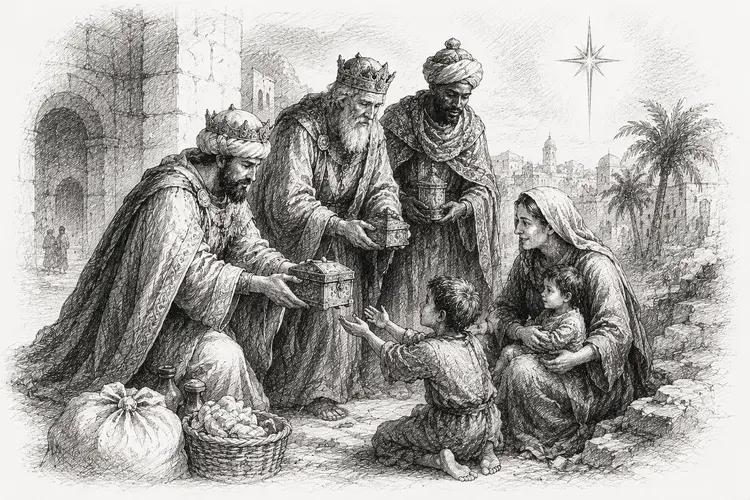
On Christmas
In just a few days, the frenetic pace of professional activity at the end of the year will come to an abrupt pause. The reason? Christmas Eve and Christmas Day, followed by a period of relative calm until New Year’s Eve and New Year’s Day—which, in many countries, will continue through Epiphany depending on local tradition.
This pause and sense of peace are both the cause and the consequence of a time devoted equally to reflection and celebration, characterized by greater closeness to family and friends and by a shared feeling of happiness and harmony. All of this, in turn, finds its ultimate justification in a fundamental element that is nevertheless becoming increasingly blurred in the collective imagination: Christmas is the feast that commemorates the birth of Jesus Christ.
It is a day of profound importance for Christians because it celebrates that Jesus Christ, the Son of God, “for us men and for our salvation came down from heaven, and by the Holy Spirit was incarnate of the Virgin Mary, and became man” (Nicene-Constantinopolitan Creed).
The coming of the Son of God to earth is an event so immense that God chose to prepare for it over centuries, and we have continued to celebrate it ever since. Although it may seem that this is no longer the case in the age of consumerism and in the secularized societies of our time, the Christian inspiration of Christmas remains present—sometimes even without awareness of its origins—in many areas of our personal and professional lives. Family life is one example; the spirit of generosity and gratitude is another.
Christianity has influenced individuals and societies as a whole by promoting values such as love of one’s neighbor, compassion, justice, and equality. These values are central to the teachings of Jesus Christ and have played an important role in the development of many institutions and practices within civil society.
Similarly, from its earliest beginnings, Christianity has encouraged charity and service to those most in need. In addition to their primary apostolic and formative mission and the administration of the sacraments, churches and Christian organizations have been at the forefront of providing social services, from healthcare and education to support for the poor and marginalized.
Christmas and Fundraising
It is precisely this Christian vision, together with the feelings of generosity and charity that it awakens in people’s hearts, that becomes particularly visible in the fundraising activities of nonprofit organizations seeking to make the most of this time of year.
In the United States, donors make 24% of their annual charitable contributions to nonprofit organizations between Thanksgiving and New Year’s Day, according to studies by the Center on Philanthropy at Indiana University. In the West more generally, half of nonprofit organizations receive more than 25% of their annual donations between October and December, according to surveys on nonprofit fundraising.
Donors are more active during this period, and organizations are well aware of it, developing campaigns, messages, and other initiatives to attract contributions. There is no doubt that, alongside the “Christmas spirit” that motivates donors at this time of year, other factors are also highly significant. In particular, the end of the fiscal year and the fact that such donations may not only reduce taxable profits and therefore affect corporate tax liabilities, but in many cases also provide donors with tax deductions or other fiscal benefits.
In short, Christmas is a season for fundraising. But above all, it is a season for philanthropy, which is what ultimately underlies the activities of both donors and recipients, even though the two concepts are sometimes used interchangeably in the language of the sector. Fundraising is simply a consequence of philanthropy understood in its genuine sense—particularly Christian philanthropy.
Philanthropy as a Christian Value
The term “philanthropy” derives from two Greek roots: philos (love, affection) and anthropos (humanity). The word therefore reflects a disposition to love one’s fellow human beings regardless of personal interest. Forms of the Greek term philanthropia appear several times in the New Testament.
In the Acts of the Apostles, Luke uses the noun to describe the disposition of the inhabitants of Melita, or Malta. These benevolent people showed extraordinary “kindness” (philanthropia) to Paul and his travelling companions after they were driven ashore on the island during a violent storm in the Mediterranean (Acts 28:2).
An adverbial form of the term also appears in Acts when describing the behavior of a centurion named Julius, who had been assigned to guard Paul while the apostle was being taken to Rome to appeal his case before the imperial court. Julius treated Paul “kindly” (philanthropos—humanely), allowing him to visit Christian friends who would attend to his needs (Acts 27:3).
The ultimate philanthropist, however, is Jesus Christ himself, whose birth we celebrate during these days. The flame of philanthropy is innate to the human spirit as a reflection of mankind’s creation in the image of God—a flame that had been nearly extinguished over the centuries by sin, and whose brightness and intensity were restored by Jesus Christ.
These days, therefore, it is worth remembering an enduring truth: “We love because he first loved us” (1 John 4:19).
Merry Christmas!