A Tale of Two Cities
Charles Dickens’s novel A Tale of Two Cities, published in 1859, is set in Paris and London just before and during the French Revolution. In the same way, the key to the upcoming European Parliament elections may lie in two other cities in Central and…
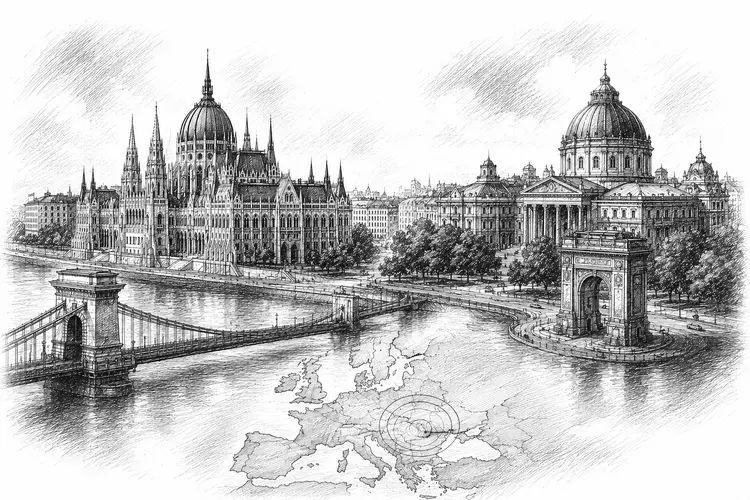
Charles Dickens’s novel A Tale of Two Cities, published in 1859, is set in Paris and London just before and during the French Revolution. In the same way, the key to the upcoming European Parliament elections may lie in two other cities in Central and Eastern Europe: Budapest and Bucharest.
These two cities, remarkable for their history, architectural beauty, and cultural richness, are the strongholds of two political forces worth watching ahead of the next electoral contest: Fidesz and Alianța pentru Unirea Românilor (AUR). The former is already a major force within the conservative right in the West and, following its departure from the European People’s Party in 2021, is looking toward the ECR Party and the ECR Group in the European Parliament as its possible next home. The latter also appears to have its sights set on the same European political family, which would make the two parties allies.
There is only one problem with this scenario: the two parties deeply dislike one another, just as their respective countries have long-standing tensions rooted in historical disputes and, above all, territorial claims.
Polls project 12 Members of the European Parliament for AUR and as many as 14 for Fidesz. In other words, despite the vast difference that currently separates these two political forces—one being a governing party and the other merely one among several opposition parties in its country—they could carry similar weight at the European level.
They would also have comparable systems of alliances. While Fidesz appears to enjoy the unconditional support of VOX, everything suggests that AUR will have Giorgia Meloni’s Fratelli d’Italia on its side. Meloni, in turn, has an emerging rivalry with Orbán over who will be crowned the leading figure of European conservatism in the next parliamentary term.
This potential tension is particularly significant. Both are prime ministers in their respective countries, Hungary begins its presidency of the Council of the European Union in July, and Meloni herself is already heading Fratelli d’Italia’s list for the European elections.
At the same time, Fidesz’s entry into the ECR Group in the European Parliament would probably lead to the departure of the Finnish and Swedish conservatives, who strongly object to what they see as Orbán’s closeness to Putin.
Moreover, AUR has more allies than Fidesz within Europe’s other major conservative political family—one that is Eurosceptic rather than reformist—Identity and Democracy, historically associated with Marine Le Pen and also home to Salvini’s Lega, which is very close to AUR, as well as the future MEPs of the CHEGA party. In short, even though AUR is smaller than Fidesz, it will be a highly desirable partner for many in European political circles.
For all these reasons, it is crucial that, without abandoning their national interests, the conservatives of Hungary and Romania raise the same banner in Brussels. Otherwise, there is a risk of a conservative civil war, something that would be disastrous during a parliamentary term in which patriotic, pro-family conservative forces defending a Christian Europe may be able to hold their ground against—and perhaps even push back—a globalist social-democratic majority that seeks to dissolve Europe’s nations into a shapeless mass stripped of identity.
This case also points to a possible paradox: conservatives are generally staunch defenders of their countries and national interests. The right is, by nature, patriotic. Yet when national interests clash so frequently, it becomes difficult to build a conservative international—or European—order. This, in turn, may prevent the emergence of a genuinely united front against the threats facing the principles defended by this political right across the Western world.
We will have our answer on June 9, when these two cities, along with so many others, converge at the European elections and negotiations begin over the entry and departure of the various political parties and parliamentary groups.