2025 in 3 Challenges
A new year begins, bringing with it new horizons and new challenges. Below, we outline the three main challenges that the Third Sector will need to address in 2025: Investing in…
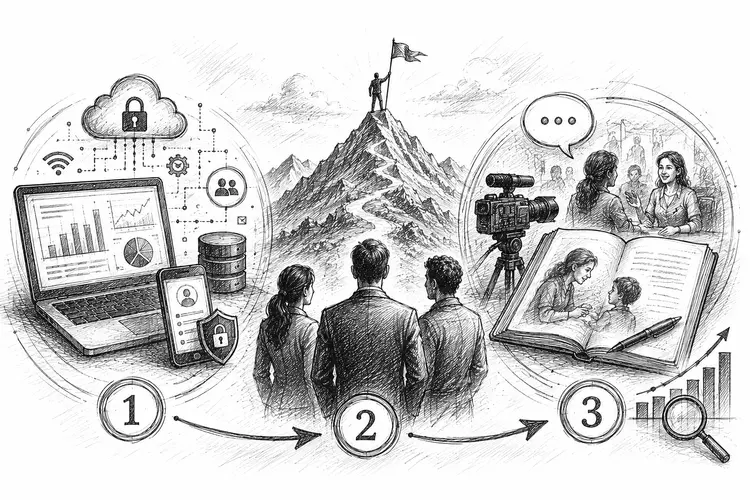
A new year begins, bringing with it new horizons and new challenges. Below, we outline the three main challenges that the Third Sector will need to address in 2025:
1. Investing in Technology
In a constantly changing and increasingly competitive environment, technology will play a fundamental role in ensuring the adaptability, resilience, and success of any nonprofit organization. The reasons are many, ranging from greater efficiency in creating audiovisual content for websites, social media, email marketing, and other channels, to cybersecurity.
Technology will also be crucial in everything related to donor acquisition, the collection of contact data, and its proper storage and use. Acquiring donor data is important, but what can be done with that data—how it can be analyzed to extract valuable insights—is equally important.
When technology “maps” hundreds of thousands of data points and uses artificial intelligence and business intelligence to generate actionable insights, an organization’s outreach, fundraising strategy, and donor management can be based on evidence rather than guesswork.
Ultimately, this is a challenge identical to the one faced by the private sector, since the technological revolution affects both sectors equally.
Of course, incorporating Artificial Intelligence into the digital toolkit will be essential; without it, nonprofit organizations will find it increasingly difficult to remain competitive.
2. Telling Good Stories
This is not a new trend and may even sound somewhat clichéd, but storytelling as an approach is absolutely essential to the branding of any organization. The Third Sector is no exception.
What is new, however, is that the story organizations tell is increasingly no longer their own, but rather the story of the people who benefit from the impact of their work.
3. Measurable Impact
For both external communication—aimed at the general public and potential donors—and internal communication—directed at current donors, boards of directors, boards of trustees, staff, and others—as well as for mandatory or recommended accountability, it is essential to measure the real impact of an organization’s actions, reports, projects, activities, and initiatives.
Likewise, it is becoming increasingly important to include observable—and therefore measurable—indicators in any project proposal if an organization wants to develop a pitch with a realistic chance of success in securing funding, partners, and other forms of support.
This is particularly difficult—especially in the field of think tanks, where measuring the impact of ideas almost inevitably requires the use of proxies—but it is quickly becoming a license to operate in this market.
Once again, this is an issue shared with the private sector, which is somewhat ahead of the Third Sector when it comes to impact measurement, particularly in the measurement of intangible assets and, above all, reputation.
As with any challenge, these three areas also represent a major opportunity for organizations that are able to integrate them into their operating procedures as early as possible, giving them a fundamental competitive advantage.